
INSTRUEX / INSIGHTS
FTIR Selection: What a Library Match Cannot Tell You
Sampling, spectral review, and software workflow matter as much as a library-search score.
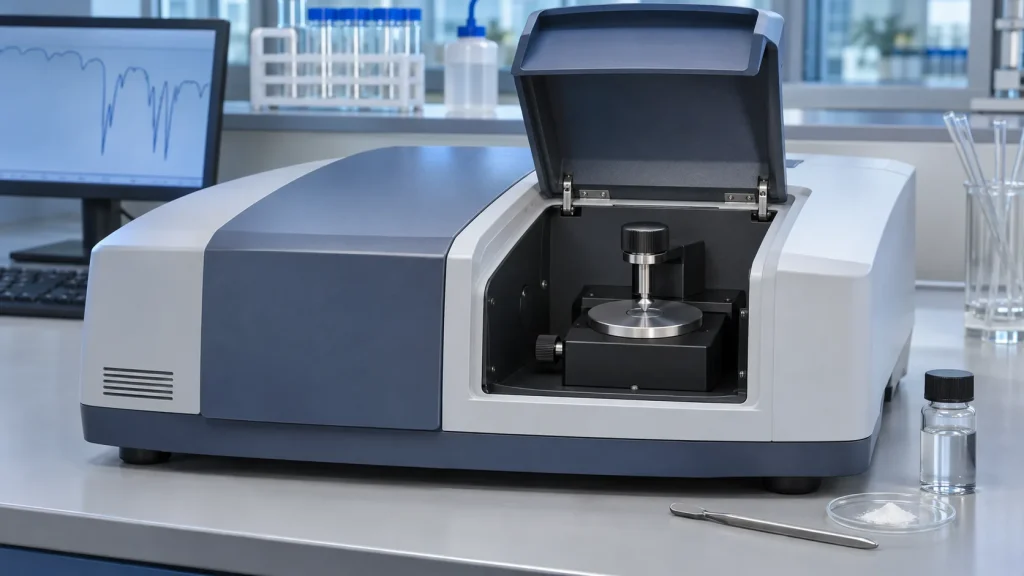
An FTIR library match can help identify a material, but the match number is not an independent verdict. Sampling technique, surface condition, spectral range, resolution, background collection, and library composition all shape the comparison. Buy the workflow that answers your laboratory’s question, not the largest library advertised on a brochure.
Define what must be identified
Separate incoming-material verification from failure analysis, polymer identification, contamination work, and quantitative measurement. Note whether samples are powders, liquids, coatings, films, or irregular solids. ATR accessories are convenient for many solid surfaces, while transmission or reflectance techniques may be more suitable for other tasks. Ask the supplier to demonstrate the proposed accessory with your own sample types.
Check the spectrum, not only the search score
Look at peak positions, relative intensities, baseline, and the regions that distinguish plausible alternatives. A close library hit can still be misleading if the sample is a mixture or if the reference was acquired by a different method. NIST provides reference infrared spectra and a broader discussion of infrared spectrophotometry; these are references for interpretation, not a substitute for your validated identification procedure.
Ask about the software and record
Request a live demonstration of background collection, spectral preprocessing, library search, manual review, annotation, export, and user permissions. Can an analyst inspect the raw spectrum and explain why a match was accepted? Can the system preserve acquisition settings and an audit trail when the task requires one? These questions are often more consequential than another decimal place in a similarity score.
Before acceptance, prepare known positive materials, likely look-alikes, blanks, and a few difficult real samples. Agree on what constitutes a useful identification and when the analyst must report “inconclusive.”
FAQ
Is a higher library match score always correct?
No. A score ranks candidates under a particular algorithm and reference set. Review the spectrum and sample context.
Do we need ATR for every sample?
No. Select the sampling accessory around material form, preparation limits, and the information required from the spectrum.